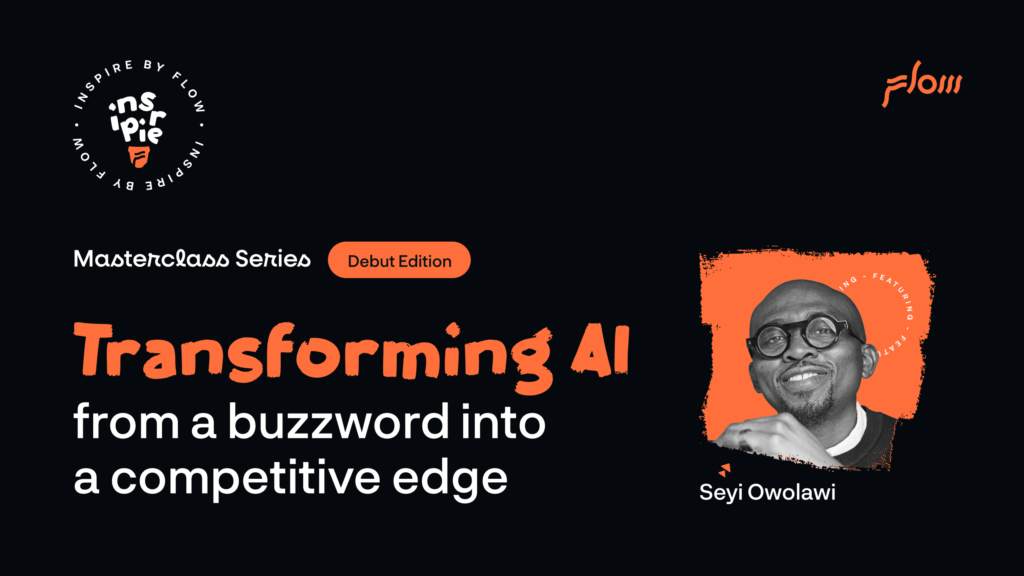
The creative and advertising industry stands at an inflexion point. AI tools have moved from experimental novelty to operational reality, yet many agencies still treat them as buzzwords rather than strategic assets. The gap between those who master AI and those who merely dabble with it is widening and it will define competitive advantage in the years ahead.
This was the central thesis of our debut Inspire by Flow masterclass on September 26th, 2025, featuring Seyi Owolawi, Head of Marketing at Newton (Europe’s leading executive VC platform).
The AI Spectrum: Where Do You Stand?
Seyi introduced a framework that categorises how people respond to AI:
-
Doom: Extreme pessimism. Skynet scenarios and existential threats.
-
Gloom: Scepticism focused on disruption, job loss, and inequality.
-
Zoom: Move fast, break things. Accelerate without concern for risks.
-
Bloom: AI amplifies human capabilities, with risks managed thoughtfully.
According to recent research Seyi cited, 750 million people use ChatGPT weekly as of September 2025—a staggering increase from 270 million in Q2. More revealing: 73% use it for non-work tasks, while Google’s search clicks have dropped 30% year-over-year.
We’re in a transition period where AI literacy varies wildly and that variance creates opportunity for those who go deeper.
Reframing the Disruption
Seyi opened with a provocative historical parallel: the fall of Rome to the Visigoths in 410 AD. Romans believed their city gates were impregnable, their systems superior. The “barbarians”—literally meaning “foreigners” in Greek—didn’t speak Latin or understand Roman culture. Until they breached the gates, sacked the city, and shattered that illusion of invulnerability.
“For every point in time in our lives, there will always be barbarians,” Seyi noted. But here’s the crucial difference with AI: “These ones are not leaving. They are the gates.”
At Cannes Creative Festival 2024, tech companies dominated the largest stages while creatives occupied smaller showcases. The shift is unmistakable: the industry that once defined cultural relevance now shares and sometimes cedes—space to algorithms that generate content at scale, analyse behaviour in real-time, and automate processes that once required human expertise.
The question isn’t whether AI will reshape advertising and creativity. It’s whether we’ll master it or be mastered by it.
Context Engineering vs. Vibe Coding
One of Seyi’s sharpest warnings centred on what he called “vibe coding”—the temptation to prompt AI, accept whatever it generates, and iterate superficially without strategic thinking.
“AI optimises for efficiency,” he emphasised, “but you and I optimise for emotions. That’s where the real difference is.”
The alternative is context engineering: embedding rich strategic context into every AI interaction, treating prompts like creative briefs rather than search queries. Just as uninspiring briefs yield uninspiring work, generic prompts yield generic output.
“We should not overly outsource how we see and how we perceive things,” Seyi cautioned. “Google used to provide information, and we drew connections. AI provides opinions, but you and I must be the judge, jury, and executioner.”
Start Small: The LNO Framework
Rather than attempting wholesale transformation, Seyi advocated for strategic, incremental adoption through the LNO Framework:
-
Leverage (L): Tasks where minimal input yields exponential returns
-
Neutral (N): One-to-one effort-to-result ratio
-
Overhead (O): High effort, minimal impact
Start with overhead tasks—the low-risk, high-friction processes that drain energy without proportional value.
What This Means for Our Industry
The advertising and creative industry has always been about solving problems through cultural insight and emotional connection. AI doesn’t change that fundamental value proposition; it accelerates it and raises the bar.
The agencies that will thrive aren’t those with the most AI tools, but those that:
-
Maintain weekly AI conversations with their teams to prevent shadow usage (employees using personal accounts with sensitive company data) and foster genuine experimentation
-
Invest learning budgets in AI subscriptions so team members have legitimate, secure access to experiment
-
Stay “Bloomers” rather than “Doomers”: Recognize AI’s potential while managing risks thoughtfully, neither dismissing it nor rushing recklessly
-
Preserve their taste: Remember that creativity legitimises technology and creates humanity. The QWERTY keyboard is objectively inefficient, but it won because it was optimised for human comfort, not pure efficiency.
As Seyi concluded: “The future is human first, but will always be AI-powered.
Moving Forward
This debut Inspire by Flow masterclass set a compelling precedent for the quarterly series we’re building.
The barbarians have arrived. They’re building better tools, faster processes, and more scalable solutions. But they still can’t optimise for what makes us human: emotion, culture, taste, and meaning.
The question facing every creative professional isn’t whether to let them in. It’s whether we’ll master them on our terms.
Inspire by Flow is our quarterly knowledge-sharing platform bringing global thought leaders together to shape conversations in the creative industry. Our next masterclass is scheduled for November 2025. Follow us on social media for updates.